|
WWW ChemTools
|
- Ion Formula by Mol. Weight
- Isotope Pattern Calculator
- Mass Loss Calculator
- Periodic e-Table
|
|
|
WWW BioTools
|
- EMBL Peptide Search - protein ID from peptide mass and sequence data
- FindMod - post-translational modifications by peptide mass
- GlycanMass - oligosaccharide mass from structure
- GlycoMod - oligosaccharide structures from mass
- GlycoSuiteDB - search database with oligosaccharide mass
- Javascript Protein Digest - peptide digest masses
- Javascipt Fragment Ion Generator for peptides
- Mascot Search - peptide mass and sequence tools
- Mowse - protein identification from peptide MS data
- Protein Prospector - mass spectra interpretation tools
- PROWL - identification of proteins from MS data
|
|

|
|
aston biography
|
|
|
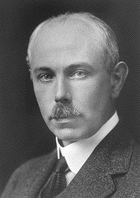
Francis William Aston was born in September 1877 in Birmingham, England, the third of seven children. He was educated at Harborne Vicarage School and Malvern College where his interest in science began. In 1894 he entered Mason College, Birmingham (now The University of Birmingham) where he studied chemistry and physics. He won a Forster Scholarship in 1898 and worked on the optical properties of tartaric acid derivatives, the results of which were published in 1901.
He spent three years as a chemist in the laboratory of a local brewery and became interested in the design and construction of new types of pumps for evacuating vessels. From this stemmed his interest in gas discharge phenomena in evacuated tubes. In 1903 he obtained a scholarship from The University of Birmingham to work on the properties of the vacuums in discharge tubes. By the end of 1909 he accepted an invitation from Sir J.J.Thomson to work at the Cavendish Laboratory, Cambridge, on studies of positive rays. It was during this period that he obtained definitive evidence for the existence of two isotopes of the inert gas neon. This research was interrupted by World War I during which Aston worked at the Royal Aircraft Establishment in Farnborough. Here he studied the effect of atmospheric conditions on aeroplane fabrics and coatings.
Returning to the Cavendish Laboratory in 1919, he again worked on separating the isotopes of neon. This led to his invention of the mass spectrograph, an apparatus which uses electromagnetic fields to separate isotopes. Extending this principle to other chemical elements, Aston discovered 212 of the naturally occurring isotopes. From these results, he was able to formulate the Whole Number Rule which states that where the mass of the oxygen isotope is defined, all other isotopes have masses that are very nearly whole numbers.
Aston continued to make measurements, using an improved instrument now on display at the National Science Museum in London. He published results of his work in the Proceedings of the Royal Society and authored the books Isotopes (1922; revised edition 1941) and of Structural Units of the Material Universe (1923).
Aston was elected Fellow of Trinity College in 1920 and received the Mackenzie Davidson Medal of the Röntgen Society the same year. In 1921 he was made a Fellow of the Royal Society and was awarded the the Nobel Prize in Chemistry the following year. He became an honorary member of the Russian Academy of Sciences and the Accademia dei Lincei, and held honorary doctorates of the Universities of Birmingham and Dublin.
Aston remained a bachelor throughout his life. He was an enthusiastic sportsman who enjoyed skiing, rockclimbing, tennis and swimming . He was also keen musician, playing the piano, violin and cello. He died in Cambridge on November 20, 1945 at the age of 68.
|
|
|
|
MS Journals
|
|
- European Mass Spectrom.
- Intl. J. of Mass Spectrom.
- J. American Society of MS
- J. Mass Spectrometry
- J. MS Society of Japan
- Mass Spectrometry Reviews
- Rapid Communications in MS
|
|
|
Science Journals
|
|
- Analyst
- Analytical Chemistry
- Nature
- New Scientist
- Science
- Scientific American
|
|
|
Literature Search
|
- Beilstein Abstracts
- ChemWeb
- Current Contents - ISI
- PubMed - NCBI
- PubScience - DOE
|
|

|