|
WWW ChemTools
|
- Ion Formula by Mol. Weight
- Isotope Pattern Calculator
- Mass Loss Calculator
- Periodic e-Table
|
|
|
WWW BioTools
|
- EMBL Peptide Search - protein ID from peptide mass and sequence data
- FindMod - post-translational modifications by peptide mass
- GlycanMass - oligosaccharide mass from structure
- GlycoMod - oligosaccharide structures from mass
- GlycoSuiteDB - search database with oligosaccharide mass
- Javascript Protein Digest - peptide digest masses
- Javascipt Fragment Ion Generator for peptides
- Mascot Search - peptide mass and sequence tools
- Mowse - protein identification from peptide MS data
- Protein Prospector - mass spectra interpretation tools
- PROWL - identification of proteins from MS data
|
|

|
|
jj thomson biography
|
|
|
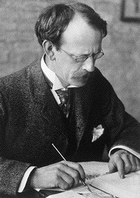
Joseph John (J.J.) Thomson was born in Manchester on December 18, 1856. In 1870 he enrolled at Owens College Manchester and six years later entered Trinity College, University of Cambridge. He became a Fellow of Trinity College in 1880 and remained a member of the College for the rest of his life, assuming the post of Lecturer in 1883 and Master in 1918. He was appointed to Cavendish Professor of Experimental Physics in 1884 at The University of Cambridge at just 28 years of age. His young age at the time was not without its critics. "Matters have come to a pretty pass when they elect mere boys Professors", one senior member of University is reported; others doubted his experience as an experimentalist. Thomson was reportedly clumsy with his hands and relied heavily on his assistants. He carried out most of his theoretical work at home on scrap paper.
Thomson's text "Application of Dynamics to Physics and Chemistry" appeared in 1886 and in 1892 his "Notes on Recent Researches in Electricity and Magnetism" was published. Thomson with Professor J. H. Poynting published a four-volume textbook of physics "Properties of Matter" and in 1895 he produced "Elements of the Mathematical Theory of Electricity and Magnetism". Thomson visited America in 1896 and gave four lectures at Princeton. These lectures were subsequently published as "Discharge of Electricity through Gases" on his return.
In 1897 that Thomson completed a study of cathode rays culminating in the discovery of the electron (click here for an audio presentation). This discovery was announced to the Royal Institution on Friday, April 30, 1897. He returned to the United States in 1904 to deliver six lectures on electricity and matter at Yale University. They contained some important suggestions as to the structure of the atom. He discovered a method for separating different kinds of atoms and molecules through the use of positive rays, an idea developed by his student Francis William Aston, in the discovery of isotopes. Thomson continued to be a prolific writer and authored "The Structure of Light" (1907), "The Corpuscular Theory of Matter" (1907), "Rays of Positive Electricity" (1913), "The Electron in Chemistry" (1923) and his autobiography, "Recollections and Reflections" (1936), among other publications.
Thomson received the Nobel Prize for Physics in 1906 (read his Nobel Prize Speech here - Requires Adobe Acrobat) and was knighted in 1908. He was elected Fellow of the Royal Society in 1884 and served as President from 1916-1920. Among his many awards were the Hodgkins Medal in 1902 from the Smithsonian Institute, Washington D.C. and the Dalton Medal in 1931 from Manchester. Thomson held honorary doctorate degrees from the Universities of Oxford, Dublin, London, Victoria, Columbia, Cambridge, Durham, Birmingham, Göttingen, Leeds, Oslo, Sorbonne, Edinburgh, Reading, Princeton, Glasgow, Johns Hopkins, Aberdeen, Athens, Cracow and Philadelphia.
In 1890, he married Rose Elisabeth Paget and they had one son, Sir George Paget Thomson (1892-1975), formerly Emeritus Professor of Physics at London University, who shared the Nobel Prize for Physics in 1937 for "his experimental discovery of the diffraction of electrons by crystals".
J.J. Thomson died August 30, 1940 at the age of 83.

|
|
|
|
MS Journals
|
|
- European Mass Spectrom.
- Intl. J. of Mass Spectrom.
- J. American Society of MS
- J. Mass Spectrometry
- J. MS Society of Japan
- Mass Spectrometry Reviews
- Rapid Communications in MS
|
|
|
Science Journals
|
|
- Analyst
- Analytical Chemistry
- Nature
- New Scientist
- Science
- Scientific American
|
|
|
Literature Search
|
- Beilstein Abstracts
- ChemWeb
- Current Contents - ISI
- PubMed - NCBI
- PubScience - DOE
|
|

|