|
WWW ChemTools
|
- Ion Formula by Mol. Weight
- Isotope Pattern Calculator
- Mass Loss Calculator
- Periodic e-Table
|
|
|
WWW BioTools
|
- EMBL Peptide Search - protein ID from peptide mass and sequence data
- FindMod - post-translational modifications by peptide mass
- GlycanMass - oligosaccharide mass from structure
- GlycoMod - oligosaccharide structures from mass
- GlycoSuiteDB - search database with oligosaccharide mass
- Javascript Protein Digest - peptide digest masses
- Javascipt Fragment Ion Generator for peptides
- Mascot Search - peptide mass and sequence tools
- Mowse - protein identification from peptide MS data
- Protein Prospector - mass spectra interpretation tools
- PROWL - identification of proteins from MS data
|
|

|
|
history
|
|
|
"This is not the place to enter into the extremely involved design of that instrument, which is as ingenious as it is exact. Suffice to say that the rays which have a constant ratio between electrical charge and mass are focussed ... (and) ... can be exactly determined with the help of a photographic plate. By this means there is attained what is known as a mass spectrogram, that is to say a series of lines in which each line corresponds to a certain atomic weight."
So said Dr. H.G. Soderhaum of the Royal Swedish Academy of Sciences in presenting Francis Aston with the Nobel Prize for Chemistry 1922. What follows is a brief overview of the history of mass spectrometry from its earliest beginnings to the present day.
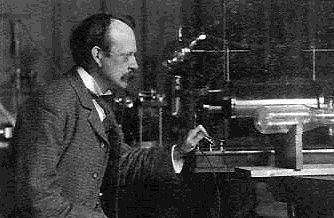
(photo) J.J. Thomson working with his cathode ray tube
- an early predecessor of the modern mass spectrometer.
Mass spectrometry has its roots in experiments performed at the Cavendish laboratory of The University of Cambridge, England almost a hundred years ago. Joseph John (J.J.) Thomson discovered that electrical discharges in gases produced ions and these rays of ions would adopt different parabolic trajectories according to their mass when passed through electromagnetic fields. This separation of ions according to their mass (and charge) is a hallmark of all modern mass spectrometry experiments.
It was Thomson's student Francis William Aston who designed several subsequent mass spectrographs in which ions were dispersed by mass and focused by velocity. This led to improvements in mass resolving power and the subsequent discovery of isotopes for many common naturally-occuring elements. Aston's second mass spectrograph is on display at the National Science Museum in London.
Both Thomson and Aston were honored for their achievements and received Nobel Prizes in Physics and Chemistry in 1906 and 1922. By the early 1920s, Arthur Dempster first in Cambridge then at the University of Chicago developed a magnetic analyzer that focused ions formed by electron impact onto an electrical collector. This design was adapted by Josef Mattauch and his student Richard Herzog, as well as Kenneth Bainbridge, Alfred Nier and others, leading to major discoveries in atomic and nuclear physics throughout the 30s. Still the early instruments were difficult to operate and esoteric in nature and it wasn't until the early 1940s that commercial mass spectrometers first appeared. Throughout the 1930s and 40s, Nier and many others incorporated the latest vacuum technologies and electronics of the time to improve the performance of the early designs. Double-focusing instruments, which combine a magnetic and electrostatic analyzer, were also introduced leading to greater mass accuracies. These instruments were originally developed for the purpose of accurately determining the atomic weights of the elements and their isotopes.
By the mid 1940s, magnetic sector mass spectrometers were being manufactured by a number of companies in Europe and the United States. This decade also saw the parallel development of the time-of-flight (TOF) mass spectrometer, a concept proposed as a cheaper and simpler mass analyzer in which ions are separated based on differences in their velocities as they are accelerated down a linear flight tube.
Sector mass spectrometers of Mattauch-Herzog and Nier-Johnson geometries were still widely being used in the 1950s to characterize organic compounds. Another type of instrument developed for the purpose of coupling mass spectrometers to gas chromatographs also emerged. The quadrupole mass filter uses a quadrupolar electric fields comprising both radiofrequency and direct-current components to separate ions. This analyzer was first reported by Wolfgang Paul of the University of Bonn, who later shared the 1989 Nobel Prize in Physics for his work on ion trapping.
By the 1960s, mass spectrometry had become an established technique for characterizing organic compounds. This was aided by the introduction of the chemical ionization source. Other so-called "soft ionization" methods emerged including field desorption, secondary ionization MS (or SIMS), plasma desorption and laser desorption MS. Several scientific journals dedicated to the field appeared including Organic Mass Spectrometry. Tandem mass spectrometry (MS/MS) came to the fore with the development of the collision-induced dissociation procedure. Tandem mass spectrometry enables structural information to be obtained for components of a mixture using two stages of mass analysis.
In 1974 Fourier transform ICR mass spectrometry (FT-ICR MS) was developed. A major advantage of FT-ICR MS is that it allows many ions to be detected simultaneously and these mass spectrometers also achieve very high mass resolution. The 1980s saw the development of ionization techniques capable of efficiently ionizing biological molecules that took advantage of these features. Michael Barber in Manchester developed the fast atom bombardment (FAB) technique which uses a source of neutral heavy atoms to ionize compounds from the surface of a liquid matrix. John Fenn and colleagues at Yale University refined an ion source originally reported by Malcolm Dole of Northwestern University almost two decades earlier to develop the electrospray ionization (ESI) technique.
Matrix-assisted laser desorption ionization (MALDI) was also developed in the late 1980s by Franz Hillenkamp and Michael Karas. In this technique, molecules are desorbed by a laser from a solid or liquid surface containing an organic matrix compound. The ESI and MALDI techniques have enabled biological molecules exceeding 1 million Daltons to be introduced into mass spectrometers as stable gas-phase ions.
Today mass spectrometers are used throughout the world to study a wide range of substances and materials with ever-increasing precision and sensitivity. Mass spectrometers are employed in astronomical studies of the solar system, in geophysics and geochemistry, for chemical analysis and more fundamental investigations of ion chemistry, in toxicology, in the environmental sciences, and increasingly in the biological and biomedical sciences.
See additional history material within the i-mass guides.
|
|
|
|
MS Journals
|
|
- European Mass Spectrom.
- Intl. J. of Mass Spectrom.
- J. American Society of MS
- J. Mass Spectrometry
- J. MS Society of Japan
- Mass Spectrometry Reviews
- Rapid Communications in MS
|
|
|
Science Journals
|
|
- Analyst
- Analytical Chemistry
- Nature
- New Scientist
- Science
- Scientific American
|
|
|
Literature Search
|
- Beilstein Abstracts
- ChemWeb
- Current Contents - ISI
- PubMed - NCBI
- PubScience - DOE
|
|

|